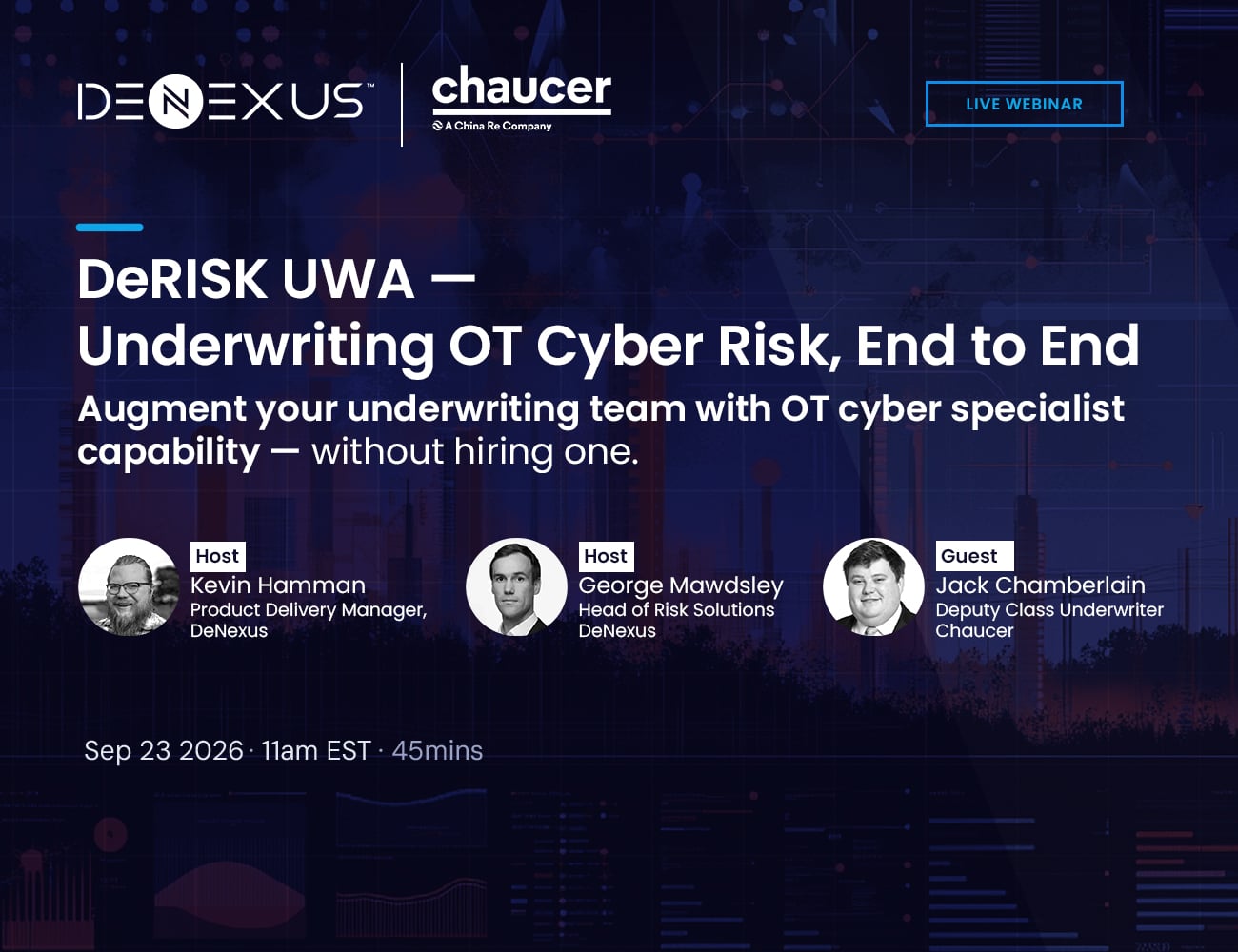
Industrial cyber risk is one of the fastest-growing and least understood corners of the insurance market. In our recent webinar, we asked a practising underwriter what's holding the market back, and what it will take to unlock more capacity for OT-heavy risks.
The panel:
- George Mawdsley, Head of Risk Solutions, DeNexus (moderator)
- Jack Chamberlain, Cyber Underwriter, Chaucer
- Neil Arklie, Head of Insurance Services, DeNexus
- Kevin Hamman, Product Delivery Manager, DeNexus
Demand is coming from both directions
Jack explained that demand for industrial cyber cover is growing on two fronts. Insurers are looking to diversify beyond traditional IT portfolios. At the same time, insureds increasingly recognise cyber as a real operational risk rather than something they can ignore. Energy leads the way, but within every sector there's a split between organisations that have assessed their exposure and those that haven't started.
The capacity gap is real
Property policies for heavy industry can carry limits in the billions. Cyber physical damage capacity is nowhere near that level yet. Jack noted that available limits have grown sharply in recent years as new carriers enter the market. He added that closing the gap depends on better information.
Neil offered a striking comparison from his time leading cyber at Lloyd's. Breach-response cover made up roughly 95% of the cyber market, while OT physical damage cover was only about 5%. The demand is there, he argued, but the market hasn't caught up.
Check what your policy actually covers
Both panellists urged buyers to look closely at their existing policies:
- Know where cover stops and starts. Cyber policies typically cover physical damage from malicious attacks. Non-malicious system failures usually fall to property, energy, or marine policies. If your property policy excludes both, you may have a gap that no cyber market will currently fill.
- A "cyber extension" isn't full cover. Neil recalled add-ons with very low limits that gave buyers a false sense of protection.
- Choose a specialist lead market. Most claims get paid. The difference is whether yours is paid smoothly and quickly, or through a long, drawn-out process.
Visibility: the number one challenge
Asked to name the biggest obstacle, Jack's answer was clear: visibility. Underwriters still work largely from property schedules. Those schedules rarely show how industrial systems are configured or connected. The unknowns force underwriters to be more conservative with both capacity and pricing.
How UWA helps underwriters see more, faster
Kevin demonstrated how UWA tackles that visibility problem. Agentic models parse lengthy broker and carrier submissions to extract what matters for OT risk and flag what's missing. In the demo, an 80-page application became a focused 16-page report in about 10 minutes. The report included risk indicators, framework benchmarking against NIST and IEC 62443, risk scenarios, pricing, and underwriting recommendations.
UWA isn't built to replace the underwriter's judgement. It's built to make informed decisions faster. Reports can also be tailored to match an insurer's own assessment framework and actuarial engine.
Note: The demo used an illustrative application, not a real client.
Coming soon: UWA freemium
A freemium version of UWA launches at the end of October. Want an early look at how it fits your underwriting workflow?
Book a DeRISK UWA demo below